You Squint, But the World Stays Blurry — It Might Be Myopia
You can read every word on your phone screen without effort. But the moment you look up at a signboard across the street — it's a blur. Sound familiar?
This is exactly how myopia (nearsightedness) feels. And if you're nodding right now, you're not alone. India is witnessing a silent myopia epidemic, with millions of children and adults struggling with deteriorating distance vision every year.
The good news? Myopia is highly manageable. With early diagnosis and the right treatment plan, clear vision is absolutely achievable.
If you or your child is dealing with blurry distance vision, consulting a trusted eye hospital in Lucknow like Abhinav Drishti Hospital can make all the difference — before the condition progresses further.
But here's the problem: many people ignore the early warning signs of myopia, assuming blurry distance vision is temporary or caused by screen fatigue. Over time, untreated myopia can continue to progress and begin affecting daily life, studies, work performance, and overall eye health.
That's why understanding myopia early is so important.
In this guide, we'll break down everything you need to know about myopia in plain, simple language — including its causes, symptoms, risk factors, diagnosis, and the most effective treatment options available today.
Let's clear the confusion once and for all.
What Is Myopia (Nearsightedness)?
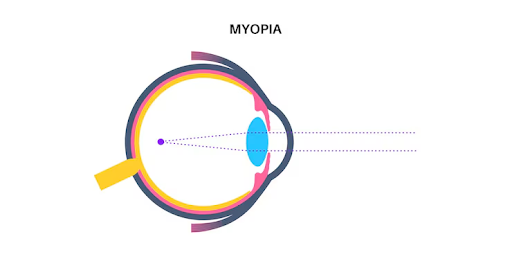
Myopia, commonly called nearsightedness, is a refractive error of the eye.In simple words: nearby objects look clear, but distant objects appear blurry.
This happens because of a structural issue in the eye:
- The eyeball grows slightly too long (axial myopia), OR
- The cornea (the clear front surface of the eye) has too much curvature
As a result, light rays entering the eye focus in front of the retina instead of directly on it — making everything in the distance look fuzzy or out of focus.
Myopia usually begins in childhood, typically between ages 6–14, and tends to progress through the teenage years before stabilising in early adulthood. However, adult-onset myopia is also becoming increasingly common, especially among people who spend long hours on screens.
Types of Myopia You Should Know
Not all myopia is the same. The severity of nearsightedness can vary from person to person, and understanding the type of myopia is important for choosing the right treatment and preventing future complications.
| Type | Power Range | Risk Level |
|---|---|---|
| Mild Myopia | Up to -3.00 D | Low — managed easily with glasses or contact lenses |
| Moderate Myopia | -3.00 D to -6.00 D | Medium — requires regular eye monitoring |
| High Myopia | Above -6.00 D | High — increased risk of retinal complications |
| Degenerative (Pathological) Myopia | Progressively worsening | Very High — requires intensive long-term management |
High myopia can significantly increase the risk of serious eye conditions such as retinal detachment, glaucoma, cataracts, and myopic macular degeneration. That's why early diagnosis and regular eye check-ups are extremely important.
What Causes Myopia?
Myopia doesn’t usually develop because of a single reason. In most cases, it is caused by a combination of genetic, environmental, and lifestyle-related factors that gradually affect the way the eye focuses light.
Genetic Factors
Family history plays a major role in the development of myopia, especially in children.
- If one parent has myopia, the child has nearly a 3x higher risk of developing it.
- If both parents are myopic, the risk increases to almost 6x higher.
- Certain ethnic populations, particularly South and East Asians, show a significantly higher prevalence of myopia.
Environmental & Lifestyle Triggers
- Excessive near work — prolonged reading, studying, or close-up activities can increase eye strain.
- Insufficient outdoor time — studies suggest that exposure to natural sunlight helps regulate healthy eye growth in children.
- Screen overuse — smartphones, tablets, laptops, and computers are strongly linked to faster myopia progression in younger age groups.
- Poor lighting conditions — reading or working in dim light may strain the eyes and negatively affect focusing habits over time.
Structural Eye Changes
Myopia also develops due to physical changes in the structure of the eye itself.
- Increased axial length (elongation of the eyeball)
- Steeper corneal curvature
- Excessive refractive power of the crystalline lens
Recognising the Symptoms of Myopia Early
Early diagnosis is the key to preventing myopia from worsening. Here are the most common signs to watch for:
In Children:
- Sitting very close to the TV or squinting at the whiteboard in school
- Frequent complaints of headaches or eye strain, especially after school
- Rubbing eyes often or tilting the head to see clearly
- Poor performance in outdoor activities requiring distance vision
In Adults:
- Difficulty reading road signs or number plates while driving
- Blurred vision during movies or watching TV from a distance
- Eye fatigue, especially after extended screen time
- Needing to squint consistently to bring distant objects into focus
Important: Many children don't complain about vision issues because they assume blurry distance vision is normal. Regular comprehensive eye exams are essential — ideally once a year for school-going children.
How Is Myopia Diagnosed?
Diagnosis is simple, painless, and takes very little time. At Abhinav Drishti Hospital, myopia evaluation typically includes:
-
Visual Acuity Test
Reading a standardised Snellen eye chart to measure how clearly you see at distance. -
Refraction Test
Using a phoropter or auto-refractometer to determine the exact degree of refractive error (your prescription power). -
Cycloplegic Refraction (especially for children)
Eye drops are used to temporarily relax the focusing muscles, giving a more accurate reading of the actual refractive error in younger patients. -
Corneal Topography
Detailed mapping of the cornea's curvature — important if surgical options are being considered. -
Axial Length Measurement
To measure the length of the eyeball — particularly useful in monitoring myopia progression in children.
Treatment Options for Myopia: From Glasses to Surgery
The goal of myopia treatment is twofold:
- Correct existing blurry vision (so you can see clearly right now)
- Slow down or control further progression (especially in children)
Here's a comprehensive look at all available treatment options:
1. Spectacles (Eyeglasses)
The simplest and most widely used option. Concave (minus power) lenses bend light to compensate for the overly long eyeball.
- Safe for all ages, including young children
- No maintenance hassle
- Must be updated as power changes
- Ideal first-line treatment for mild to moderate myopia
2. Contact Lenses
Soft contact lenses or rigid gas-permeable (RGP) lenses worn directly on the cornea.
- Better cosmetic appeal than glasses
- Wider field of vision
- Require proper hygiene and care
- Available in daily, monthly, and extended-wear options
Specialised myopia control contact lenses (like MiSight® daily lenses or centre-distance multifocal lenses) are now available to slow myopia progression in children.
3. Orthokeratology (Ortho-K / Night Lenses)
Specially designed rigid lenses worn overnight that gently reshape the cornea while you sleep.
- You wake up with clear vision — no glasses or lenses needed during the day
- Particularly effective in children for slowing myopia progression
- Results are temporary; the cornea returns to its original shape if lenses are stopped
- Ideal for active children and teenagers in sports
4. Atropine Eye Drops for Myopia Control
Low-dose atropine (0.01%–0.05%) eye drops are one of the most evidence-backed treatments for slowing myopia progression in children.
- Applied once daily at bedtime
- Studies show up to 60–77% reduction in myopia progression
- Minimal side effects at low doses
- Often combined with ortho-K or MiSight lenses for maximum control
5. LASIK Eye Surgery
For adults (typically 18+ with stable prescription), LASIK is the gold standard for permanent vision correction.
Lasik eye surgery in Lucknow at Abhinav Drishti Hospital uses advanced laser platforms to precisely reshape the cornea, correcting myopia, astigmatism, and even mild farsightedness.
- Procedure takes under 15 minutes per eye
- Most patients achieve 6/6 (20/20) vision or better
- Minimal discomfort, fast recovery (24–48 hours)
- Suitable for myopia up to approximately -8.00 to -10.00 D (depending on corneal thickness)
LASIK is not suitable for: patients with thin corneas, very high myopia, keratoconus, or unstable prescriptions.
6. SMILE (Small Incision Lenticule Extraction)
A newer, flapless laser procedure — considered the next evolution after LASIK.
- No corneal flap is created (safer for dry eye patients)
- Tiny incision, minimal disruption to corneal nerves
- Excellent results for moderate to high myopia
7. ICL (Implantable Collamer Lens)
For patients who are not suitable for laser surgery (very high myopia, thin corneas), an ICL is a brilliant alternative.
- A biocompatible phakic lens is implanted inside the eye, in front of the natural lens
- Does not involve removing corneal tissue
- Reversible procedure — the lens can be removed or exchanged if needed
- Ideal for myopia ranging from -3.00 D to -20.00 D
8. Refractive Lens Exchange (RLE)
In patients above 40 with high myopia and early presbyopia, the natural lens is replaced with an artificial multifocal intraocular lens (IOL).
- Corrects myopia AND reduces dependence on reading glasses
- Permanent solution
- Similar to cataract surgery in technique
Myopia Treatment Options at a Glance
| Treatment | Age Group | Best For | Permanence |
|---|---|---|---|
| Glasses | All ages | All levels of myopia | No |
| Contact Lenses | 8 years+ | All levels | No |
| Ortho-K Lenses | 8–18 years | Control progression | Temporary |
| Atropine Drops | 6–18 years | Slowing progression | No |
| LASIK | 18+ (stable Rx) | -1 to -10 D | Yes |
| SMILE | 18+ | -1 to -10 D | Yes |
| ICL | 21–45 years | High myopia | Yes (reversible) |
| RLE | 40+ | High myopia + presbyopia | Yes |
Myopia in Children: What Every Parent Must Know
Children's eyes are still developing, which makes early intervention especially important.
Warning signs in school-going children:
- Grades dropping because they can't see the board
- Sitting too close to any screen
- Frequent complaints of headaches during or after school
What parents can do:
- Schedule comprehensive eye exams every year from age 5 onwards
- Ensure children spend at least 90 minutes outdoors daily (sunlight helps regulate eye growth)
- Limit screen time to recommended levels (no more than 2 hours/day for school-age children)
- Avoid prolonged uninterrupted near work — encourage the 20-20-20 rule: every 20 minutes, look at something 20 feet away for 20 seconds
Myopia Progression: When Should You Worry?
Myopia that increases by more than -0.75 D per year is considered rapidly progressive.
Watch for:
- Frequent changes in spectacle power
- Complaints of worsening vision despite recently updated glasses
- Power above -6.00 D at a young age
Complications of untreated high myopia include:
- Retinal detachment (vision-threatening emergency)
- Glaucoma (damage to the optic nerve)
- Myopic macular degeneration (permanent central vision loss)
- Early onset of cataract
These complications make it critical to not just correct myopia but actively manage and control its progression.
Why Choose Abhinav Drishti Hospital for Myopia Treatment?
At Abhinav Drishti Hospital, Lucknow, we take a personalised, evidence-based approach to every patient's vision health.
Here's what sets us apart:
- Advanced diagnostic technology — corneal topography, OCT, axial length biometry, and more
- Comprehensive myopia control clinic for children — including ortho-K, atropine therapy, and MiSight lenses
- State-of-the-art laser vision correction — LASIK, SMILE, Contoura Vision
- ICL and phakic IOL implantation for patients not suitable for laser surgery
- Experienced ophthalmologists with sub-speciality training in refractive surgery and paediatric ophthalmology
- Patient-first care — every treatment plan is tailored to the individual's age, prescription, lifestyle, and goals
Your vision deserves more than just a prescription. It deserves a long-term plan.
Book your comprehensive eye evaluation today at Abhinav Drishti Hospital.
FAQs
Disclaimer: This blog is intended for general informational purposes only and does not constitute medical advice. Please consult a qualified ophthalmologist at Abhinav Drishti Hospital for diagnosis and personalised treatment recommendations.